Wednesday, July 26, 2017

My Review Of Formula Student 2017

Pic; Stefan Ruitenberg
Hello there!

It's that time of the year, Formula Student time, and what four-day event we had. But first, I have to start off with a little moan. This year's event saw a big drop in the number of cars competing. And I believe this is down to two things: a technical regulation boycott which saw a number of electric teams being given penalties for power modes or that the event in Hungary is just more suited to what they want. This saw the likes of TU Delft, Munich, Aachen and Stuttgart all skipping the Silverstone event.

I find this a real shame, as the cars they bring over really are exceptional, but that doesn't mean exceptional and well-engineered car were not on show, as they were. With these main heavyweights not here, this meant the door was opened for the teams with smaller budgets to really perform. Thus seeing Cardiff University winning the overall event (Typically I never get images of their car do I ...) and the University of Birmingham coming in 2nd place overall.

The purpose of this feature is to look at the technical advancements of 2017, with many great ideas on display. Even some of the outfits with smaller budgets managed to be innovative with their cars. Let’s take a look at what’s what.

Pic: Stefan Ruitenberg
Firstly, I want to talk about the quality that was on show. In the header image is UH Racing and the image above is Team Bath Racing, both of which had outstanding quality race cars. It has to be said that the pair are both well-funded teams, but interesting they run different car philosophies. Starting with UH Racing, who run a steel space frame as a foundation, which saw everything else being mounted too. What I like here is that the space frame is very light, with an overall car weight of 210Kg. Don't forget that car has a full aero package and a four cylinder engine too.

With Bath, on the other hand, they run a carbon monocoque, which is a bit easier to apply the engine and wings too I gather from some of the engineers in the German teams. Amazingly Bath managed to get a total weight of 170Kg, which is very impressive. It makes, my University (Team HARE) car look like a heavy weight boxer, weighing in at 250Kg's. Which goes to show lots can be gained or lost with the direction of the chassis. So think about what direction the car will go.

But, the pair both run similar front wing concepts, we can note a growing trend with the design and application of it. Nearer the chassis, teams nowadays seem to apply small flaps to move the flow clear of the outboard suspension components and upper/lower wishbones. Something used by both Bath and Hertfordshire.
Pic: Stefan Ruitenberg
With the aerodynamics this year, it remained a stable curve with nothing major being on show, apart from Brooks's front wing or maybe Maribor's rear wing end plates, more of later. Starting at Oxford Brookes, their front, which I managed to snap above, shows a more Formula 1 style front wing set up.

The wing see's no end plates, and a fairly advanced cascade and turning vane. Here Brooks is trying to control the front wheel wake via channelling some high energised flow downstream of the chassis so that the rear wing and diffuser work better.

It has to be said Brooks had some nice side pods and diffuser too. But Brooks always shows up with a well-made car. I also love the livery for this years car.
Pic: Stefan Ruitenberg
The other thing I did find rather interesting was Maribor University from Slovenia. Their car, shown above had really long end plates on the rear wing set up, which ultimately ran to the diffuser edges, which I think is a way to seal the floor edges by reducing the vortex it sheds or maybe controlling the turbulent flow of the rear tyres, but I am not 100% on that.

Interestingly, Maribor uses carbon brackets for the rear jack mounting point (orange steel tube at the rear). This is something new to FSUK, and will certainly take out some weight, that's if it's strong enough to support said car.
Pic: Stefan Ruitenberg
Above we can see a more conventional rear wing, as seen here on Karlstad University's car. They even used CNC'd swan neck pylons to partially mount the rear wing set up too. The wing was made up of two carbon end plates with three aerofoils mounted in between to provide the downforce. Again, the quality of this car was very high, and performance was good, thus giving the car 3rd place overall.
Pic: Stefan Ruitenberg
For suspension, I have to admit that I was quite impressed with what was on show this year. With the cars all having suspension front and rear, it is very important you control the loads and forces that go through the chassis, which is why machined bulkheads are now being applied both front and rear of the cars we see racing.

This very set up can be noted in the image above, which is the car from the University of Birmingham. They, like many teams, ran a CNC'd aluminium bulkhead which was mounted at the back of the car. This means the spring and dampers could be mounted on it, over the chassis, thus reducing stress, giving it a longer life.

"Making your car fast and looking great is easy but making your car reliable is what counts" Rob Bartley (Leeds University Mechanical Engineering Student) 

The push rods from the bell cranks went to the wheel hubs, which ultimately gave a neat rear configuration. I think this will grow in trend over the next couple of years.
Pic: Stefan Ruitenberg
For the front suspension, I have noticed a growing trend on mounting the main components on top of the chassis, as years before saw them mounted on the floor, or the sidewalls of the chassis. Here we can see Lancashire University's car, who applied them to the top of the car. And while you affect the aerodynamic performance, I think it's better to do this for loads, as you are able to deal with more vertical and horizontal loads. You can even use this concept to apply a Z-type anti-role bar too.
Pic: Stefan Ruitenberg
Here we can see what I spoke about above, where the spring and damper are applied to the chassis, as seen here on Team HARE's race car. At low speeds, this concept is good as its light and simple, but at high speeds means the forces being applied by the tyre contact patch could break welds in the chassis. So I think it's good to have the extra weight of a bulkhead to deal with the suspension loads.
Pic: Stefan Ruitenberg
While I was walking up and down the grid, I noticed that there was a really high standard of engine packaging on some of the ICE cars. In my image above, is UH Racing from the University of Hertfordshire, who are running a Honda CBR500R inline four, producing 65bhp.

This is the best image I got of the engine packaging, But from what you can see here, it was very tidy, with a nice location of the intercooler and air filter. I was also very impressed with the final drive mechanism and the cleanness of the exhaust system, which made for one high-quality car. I think this was probably the best condition car at the event.
Pic: Stefan Ruitenberg
Another team who showed real classy ICE package was the guys from Huddersfield University or Team HARE. Who for the first time is competing with a Triumph engine. The engine in question is a 95 bhp 675 3 cylinder, which was used over the 1 cylinder KTM used in the year before. The reason for this change was down to reliability. 

Team HATE powertrain manager says “The powertrain packaging for HARE-17 has proven to be challenging because whilst the size of our space frame has remained a similar size to previous years we have introduced a larger power unit in the form of a Triumph Daytona 675 IC engine. As such components such as the fuel tank and exhaust have been optimised in order with the limited space allocated for each. HARE-17 has also adopted a shorter wheel base which means special consideration had to be paid to packaging the drivetrain in order to keep the drive shafts as straight as possible”.

Pic: Stefan Ruitenberg
I would also like to talk about Leeds University Race Team, who managed to pick up the Spirit of The Race award by Willem Toet. For the people who may not know, Willem is a legendary aerodynamic engineer from formula 1, who has the likes of Ferrari, Benetton and Sauber on his CV.

Once the award was given, Leeds team leader, Tomas Brignell said “I think it is a testament to the strength of the Leeds team that members who were part of the team purely on their own volition were able to pass the car through both tech and scrutineering without having been involved in the actual design process. Their dedication and teamwork exemplify everything we as a team and a university stand for. I would like to express my sincerest thanks to both Mr Toet for recognising their commitment and the students themselves for all of their hard work at competition and throughout the year.”

That concludes the technical advancements of 2017 Formula Student UK, where all the teams will have to do it all over again with brand new race cars. And the quest continues for a British team to win the event overall, as this year Wales did with Cardiff University, so a big congratulations goes out to them.

Now, to get ready for Germany and Hungary events! 

Tuesday, July 18, 2017

Under The Skin Of The Ligier JSP2 17

Pic: Stefan Ruitenberg
Hello there!

This year, just before my exams, I went off to Silverstone for the 1st round of the WEC season. And as the title shows, this feature looks at the brand-new Ligier JSP2 17 race car. 

I was lucky enough to have been given a full tour of the car in the ELMS paddock, so here is some pictures and some text which explains what I learned from speaking to the team engineering at the event. 

One thing which did stick out though is that these P2 prototype cars are cheaper to run and buy than GT LM cars, which really did shock me. I think this is one of the reasons we only see one team outfit in the pack, which is utterly dominated by manufacturers. Now, let's take a closer look!
Pic: Stefan Ruitenberg
Starting with the braking system, we can see the installation of the front mounted brakes, uprights and wishbones.
Pic: Stefan Ruitenberg
Then here we can see the rear brakes. Note that they use less cooling holes here, as the brake bias is more towards the front on the Ligiers, thus seeing a bigger temperature on the front setup to the rear.
Pic: Stefan Ruitenberg
Moving onto some rear aero, the car use's swan neck pylons mounted to two aerofoils which make up the rear wing. Its is fully made from carbon fibre. 
Pic: Stefan Ruitenberg
On the side of the car, we can see the intricate details of the side pod turning vanes and flaps. These are placed to control the flow that enters under the nose. This air is then moved to the back of the car, i.e. rear wing and the diffuser.
Pic: Stefan Ruitenberg
The power train is nothing too special. The regulations dictate all LMP2 teams must run the GK428 4.2 V8 engine, as shown here. It is a 90 degree V which is naturally aspirated. 
Pic: Stefan Ruitenberg
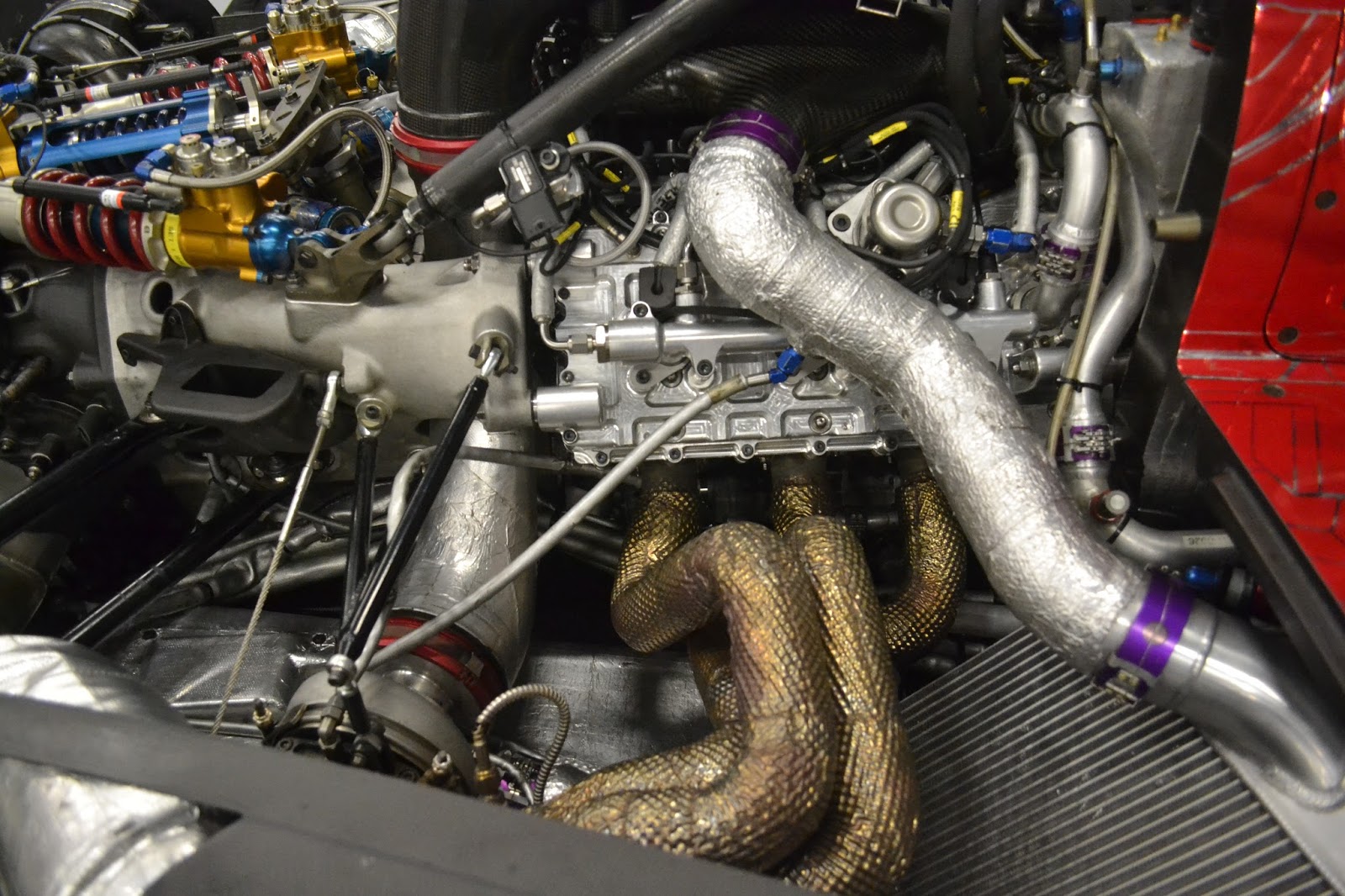
I was able to get a closer look at the engine, shown above. Here we can see the rather small carbon plenum and oil cooler. The engine is a stressed member, so extra rigidity is added via the steel tubes connecting to the tub to the bell housing. 
Pic: Stefan Ruitenberg
Above shows the rear brake cooling tube, which is fed air by the outer bodywork of the car. Also note the small nature of the manifold. 
Pic: Stefan Ruitenberg
When deep in the rear engine bay, we can see the alternator, which is supplied by Mclaren Technologies. Also note the driveshaft and double upper and lower wishbones, which are made from steel. 
Pic: Stefan Ruitenberg
Here we can get a good look at the rear end. Note the new end plate design. This whole assembly is one piece too. So easy to swap if damaged. 
Pic: Stefan Ruitenberg
I was very happy to see inside the car, which is very compact! I wish I was a driver... 
Pic: Stefan Ruitenberg
In this image, I was able to get a closer look at the Cosworth supplied steering wheel, which is super cool! 
Pic: Stefan Ruitenberg
Back to the aerodynamics, the rear deck has louvres and a NACA duct to help feed air as well as bleed some away from the engine and gearbox.
Pic: Stefan Ruitenberg
In this picture I tried to be arty. But, you can see the main heave springs at the back. The car also uses another spring as a third element, so I believe that would be for aero load? Also, note the exhaust positioning.

I hope you like this piece, as these LMP2 cars are quite quick, so It was good to look around the 2017 Ligier. I will try to do  more car tours in the future.

Thursday, July 6, 2017

Bolt-on Macpherson Strut Project:

Pic: Stefan Ruitenberg
Hello there!

People who may know me will know I am easily inspired, by a lot of things. My latest project stems from Porsche 911 race car and Mustang/Civic BTCC race cars too.

The project entails a bolt-on subframe which houses a fully optimised suspension system, as shown above. In cheaper series of racing, I have seen it is easy to disassemble the suspension, but this takes a lot of time, so I hope my design can reduce that.

For now, I have used Porsche style Macpherson Struts as a form of damping the movement through the tyre contact patch. But this will change to a heave spring along with a third element. Which is more ideal for UK club racing.

So far, I have made my model for the rear end of a Caterham 7 kit car, But I want to make a concept to fit a Radical SR1 etc.

I also want to make the files completely open-source, so you could even manufacture the assembly, as I can't do that currently.

For now, I will motor on with the Solidworks CAD file, and try to improve my model via FEA, of which will be displayed on my blog.

This is also non-academic, so I see it as using my time well, before I go back to university.

Wednesday, June 28, 2017

Formula Student Diffuser project:

Hello there!

I can't hide of been a little bored with being at home. So I have been filling my time with lots of maths and CAD work lately and trying to improve my abilities in both.

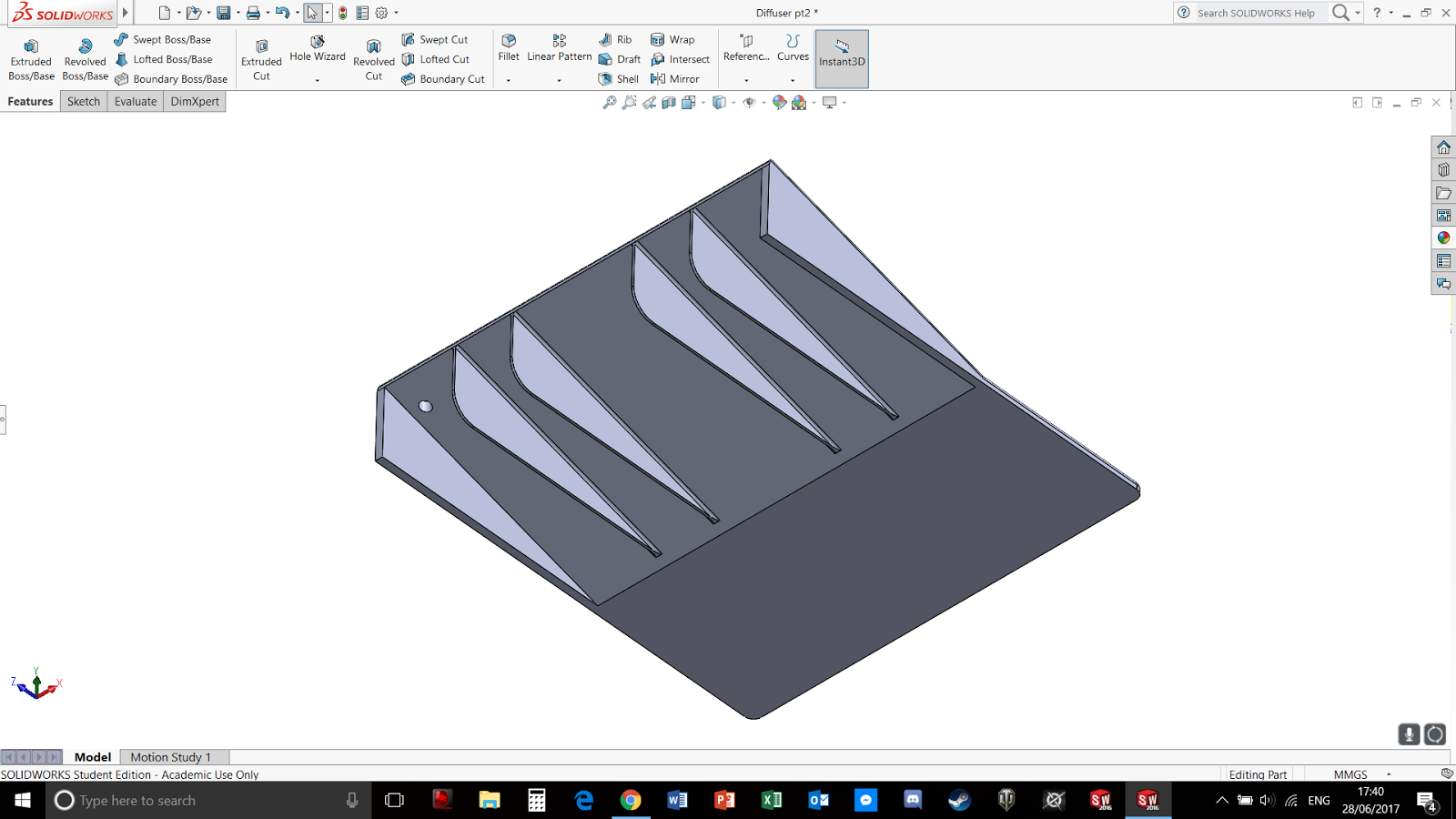
Below you can see a makeshift diffuser I've built in Solidworks. Iv applied a 16-degree angle of attack, which is not too far off what they have in LMP2 class at Le Mans.

As you can see, I've applied slats to the design, which is believed to control the low-pressure flow better, as it exits the car, thus reducing drag. So it will be good to see how this works.

Pic: Stefan Ruitenberg
My next step is to get some CFD on the design, then do a small paper on what I found out. I will make sure I publish my finding on here too.

Now, back to modelling.

Tuesday, June 27, 2017

My Analysis Of F1 2017's Unique Designs

Hello there!

It has to be said, that the 2017 Formula 1 season has been a season draped with action. So much so that, we have a new protagonist alongside Lewis Hamilton, which has to be said, the most dominant driver of this new hybrid era of single seater F1 racing.

This resurgence of Ferrari has given us a classic so far, Ferrari vs Mercedes, which even of the track has given us a lot to talk about. But people who know me will know my love for Engineering, and for the purpose of this article, I will be doing just that. Let's take a look at the unique technical designs of 2017, shall we?
Pic: Craig Scarborough
Red Bull Nose 

Ever since low noses were brought into the technical regulations, that year being 2014, teams have tried several ways to improve flow efficiency and blockage at the nose's tip. The main outcome here is to maximise as much flow to the underside of the car. There have been numerous attempts at achieving that net outcome: for example, back where the regulations were released, teams applied a finger-like tip to the first FIA regulatory box, which meant teams gained back some of the advantages the high-nose had. Thankfully this avenue was not brought forward in the next batch of regulations and thus gave us more aesthetically pleasing race cars.

One team to run a new concept in 2017, who's nose is quite a neat solution was Force India. Thier design incorporates two holes either side of the nose tip. But where this idea really shines is that from any viewing angle, you cannot see directly through them, making it a legal design. I did think this idea would catch on but seems it hasn't.

For the 2017 season, Red Bull Racing has gone down its own path in this area of regulations. The RB13 sports a small inlet on the nose tip, which after further investigation, it appeared to allow air to pass through, with eight small vanes to make the design legal to race.

This design is more interesting than meets the eye, as the duct allows air to pass straight through, but also it is able to move the flow up the underside of the nose. The car also uses an S-duct which helps reduce the high-pressure flow under the nose, by bleeding the boundary layer to the upper part of the chassis.

Beyond the nose concept, the  RB13 remains quite conservative with the aero surfaces. Speaking to a senior engineer on the matter, they believe that, that lies in the car's philosophy.
Pic: Craig Scarborough

Mercedes Chimney 

During pre-season testing in Spain, Mercedes caused quite a stir when the sheets on the W08 were pulled away to the public and media. As shown above, the WO8 appears to have a vented section which runs along the lip of the engine cover, thus giving the name 'the chimney'.  A common mistake is that people believe this is entirely new, but that would be false. As this style of the vent was seen in the early 2000's, where teams like Sauber or McLaen mounted ducts like this to the leading edges of the side pods. This was down to the tight nature of the regulations which did not permit many cooling vents.

The reason why they are a good idea is that they are much more efficient, an engineer's favourite word I find, and I agree. Back to the point, These vent's are mainly in areas of flow sensitive body work,  so my mounting one of these almost hidden vents, turbulent flow is somewhat reduced.

In Mercedes's case, the 2017 rear wing regulations, of which are lower, has meant Mercedes found this small window, in which can vent some of the temperatures given off my the mechanical side under the body. With the mainplane lower, this flow exiting the car shouldn't get in the way of the wing, thus not compromising downforce levels.

It is unclear to what Mercedes are venting here, but my best estimate would auxiliary cooler, which from research sits fairly high of Mercedes-powered performance cars. This would likely cool the MGU-H. It is believed Ferrari have something similar.
Pic: Craig Scarborough
T-wings And Fins

The rear mounted fins that hang of the back of the engine covers are not new to Formula 1 cars. However, the 2017 regulations brought a small loophole, what which Mercedes found, thus seeing the rest of the field follow.

This loophole is a 50mm wide strip along the car's centerline (25mm either side of the line) which has now been used to enhance the car's performance. As seen in the image above on the Sauber, the T-wing is made up of aerofoils, so produce downforce in their own right. This is done by inverting the ratio of 'drag to lift', something that is so crucial to making these F1 cars work. And as found out by Williams, who run three aerofoils, there is no limit to how many you can run unless the structural integrity is not met, then the FIA will step in.

As with all aero surfaces, dorsal fins also have a major impact on the overall performance of the race car. In one basket, they do indeed provide some effect in conditioning the flow to the rear wing. In other words, reducing the turbulent wake given off my the some of the aerodynamic elements placed at the front or side of the car.

But after speaking to a senior engineer in the aerodynamic field, there use lies deeper than that. In vehicle dynamics, yaw is the enemy of any engineer, so when the car is sliding on entry, team's will do anything they can to prevent this.

The fins play a vital role in pressure difference. Although dependant of where the wind is blowing, it will create a high-pressure region, thus pushing that part of the car down. But when the cars are mid-way through the corner, the fin becomes cambered, thus providing even more rearward downforce. But as I was told, this area can be a sensitive area to offset the overall balance of the car.

This is one of the very reasons we see this fin's on prototype race cars, as the high-pressure area prevents these cars from flipping under high-speed yaw. This can be noted in the 2016 Silverstone 6h WEC race as well as every NASCAR race with the flaps mounted on the outer bodywork. Let's just hope the FIA don't ban them, as I'm quite a fan of T-Wings and dorsal fins.

I hope you enjoyed the post!

Sunday, June 25, 2017

Under The Skin Of The Rebellion R-One

Pic: Stefan Ruitenberg
Hello there!

The Rebellion R-One was a very successful LMP1-L car, with an array of wins to its name. I was able to get closer at Silverstone last year and was able to get some pictures, so big thanks to the team for allowing this. 

It's was a car which beat its light rivals ByKolles Racing quite often, and It has to be said that the bigger team was just more professional than their rivals. Let's take a closer look. 

Pic: Stefan Ruitenberg
Starting off at the bulkhead, we can see the torsion bar, as well as the steering rack. The team has also labelled the brake and clutch reservoirs too. Also, note the sensor connector and pins that mount the nose to the tub too.
Pic: Stefan Ruitenberg
Compare to the Rebellion bulkhead, to the ByKolles one. It looks to be less complex, but this could be down to the tub design and the way they have packaged the internals. 
Pic: Stefan Ruitenberg
This small hatch is on top of the tub of the chassis and is for the mechanics. This image here shows where the driver's legs are placed also.
Pic: Stefan Ruitenberg
For the front suspension, the car has push rods, as shown above here. We can also see the aluminium and steel upright and wishbones too. For the brake duct, one pipe feeds the calliper, and one feeds the disc.
Pic: Stefan Ruitenberg
For the stopping power, the car has 6 pot callipers, and a vented carbon-carbon brake disc too. Note the temperature sensor being used here.
Pic: Stefan Ruitenberg
Likewise, to the CLM, the car uses a twin turbo AER V6, as you can see here. The car has twin charge air coolers in the side pod, one for engine cooling, and the other for the turbines. Also, note the small plenum and coil sprung suspension laid close to the transmission casing. For rear brake cooling, the team use a tube from the rear fender arches.
Pic: Stefan Ruitenberg
Here I was able to get a closer look at the turbocharger the engine has. The car has two of these and has over 600bhp. This thus has given the R-One a high top speed, often the fastest at WEC races I learned.
Pic: Stefan Ruitenberg
Here we can see the manifold, with has some coating to keep heat in, which then goes into the turbine. Note the intercooler piping and support bars going from the tub to the bell-housing.
Pic: Stefan Ruitenberg
Compare the installation to the ByKolles car, above. Which shows they have another cooler mounted in the side pods. Also, check the rearward intercooler mounted at the back of the car, just above the red spring units. 
Pic: Stefan Ruitenberg
At the very back end of the car, we can see the FIA regulated diffuser, and the gearbox oil cool, mounted at the very back of the casing. Note the plank of wood under the car too, which provides the FIA information on how low they run the race car. 
Pic: Stefan Ruitenberg
Although I took this out of focus, you can see this is one of the four coolers, as used by both ByKolles and Rebellion Racing. They are manufactured by US firm PWR.
Pic: Stefan Ruitenberg
For the floor, we can see 1/50th of it here, as the mechanic washes it. It's made from full Carbon.
 
Pic: Stefan Ruitenberg
A good look can be seen in the livery here, which I love. This is the front nose cone, note the blended brake cooling duct suggesting this is a low drag front. 
Pic: Stefan Ruitenberg
Compare the nose to the ByKolles high nose concept, which uses turning vanes to produce downforce, as well as using the high nose to apply more low-pressure flow under the chassis, thus improving the performance of the rearward diffuser. 
Pic: Stefan Ruitenberg
Above shows the rear bodywork assembly. Note the popular swan neck pylons and rear deck gurney flap.
Pic: Stefan Ruitenberg
For sure these are my favourite wheels from WEC paddock. They are made by O.Z Racing and made from full magnesium.

I hope you liked this little piece! 

My Analysis Of The SMP BR01 LMP2 Car

Pic: Stefan Ruitenberg

Hello there! 

It’s going to be a great shame that the BR Engineering SMP Racing BR01 LMP2 car won’t be able to race from 2017 onwards, due to new chassis regulations from the FIA and ACO, whereby SMP was not chosen. Having introduced the car in 2015, the year before really saw the project take off in the design and manufacturing side of things. Let’s take a closer look.

At the start of 2014, right the way to February in 2015 saw the car built, developed and even tested, albeit there was very minimal running time. Going back to when the car got the green light, SMP was able to draft in legendary designer Paolo Catone who penned one of the greatest LMP1 cars, the Peugeot 908.

One of the rules in LMP2 state that any chassis builder must be able to sell your products to a customer team. Even though Strakka and Dome dodged that bullet through a loophole with its S103, SMP wanted to stay true to the regulations, “We wanted to play things properly. We wanted a car that can suit all types of drivers in the spirit of the regulations.” says Catone when he was speaking to Lawrence Butcher in Race Engine Technology Magazine (RETM). Although Catone was able to find that loophole, he felt it was not right for the team to go down that direction, such as Strakka Racing did.

SMP wanted Catone to develop the car by himself, which for anyone is a big undertaking. “when I undertake projects such as the BR01, I have to use my network of supplies and people to do the design work. I have built up a reliable network of manufacturers who are very competent and reactive to my needs” says Catone in RETM. One of these companies was Fondtech, who was able to design and develop the aerodynamic package. Sub-contractors were key for SMP Racing in manufacturing and design of its new LMP2 car.
Pic: Stefan Ruitenberg

Chassis

Starting off with the chassis, the car uses carbon fibre composite tub and outer bodywork panels, of which have been made by Italian company ARS Technology. The key areas where BR Engineering looked at was the front bulkhead and driver cockpit, of which has been developed to work outside of the box, on which is explained later.

The SMP BR01 does share some similar areas to the other P2 cars in races with, such as the Strakka Dome and Ligier JS P2, of which all use a high level of detail to fine tune the overall balance of the car. Some of the key areas they have looked at are the front splitter, side turning vanes and rear deck.

“Our car is very tightly packaged, as we wanted it to be as small as possible, so that weight was down, as well as giving a suitable foundation for the aerodynamics.” Says Catone. He later hinted “that there are very little compromises” which he is very happy about as said in RETM.

Catone wanted his prototype car to be able to run at the front of the pack, and not just with professional drivers. This means that drives of all shapes and sizes must be able to race it. This, of course, needed some neat design features to be able to make Catone’s idea come true.

To achieve this, the car needs to be comfortable, and so BR Engineering had to modify the survival cell at best to improve the accessibility and visibility. This is something all drivers want but can give the car a compromise in the aerodynamic department. On the SMP car, the cockpit is bigger to the one used on the Ligier JS P2 and Oreca O5, but amazingly it's lower.

One key area the team improves was the windscreen surround, which is much thinner. While this gives the driver better viewpoints, the structural integratory was the same thanks to some neat ideas with the carbon fibre honeycomb structure.

Another area where SMP went to town was the doors, which is actually bigger than the regulations states. Cantone says “Driver change in key” so opted to use bigger doors to help the drives by getting into and out of the car. This approach means the teams can get quicker pit stops, which no compromises have been made with the aerodynamics of the bigger doors. Although the doors took longer to manufacture, and are more expensive, the car is not compromised in the area.
For the rear, steel composite tubes come from the back of the survival cell to the spacer in between the gearbox and engine, which makes it a type of hybrid chassis design.

Pic: Stefan Ruitenberg
Suspension systems

While the chassis stands out from current LMP2 cars, the suspension, in fact, does too. The design on the Strakka, Oreca and Ligier cars have torsion bars with a heave spring. The suspension up front on the BR01 is coil springs mounted horizontally in the bulkhead. There is a myth that this can compromise the tyre contact patch, but there is zero difference here.

The only place it will differ is the damper unit would become a damper spring unit, so it’s a bit bigger in diameter to the ones used within a torsion bar set up. I can confirm that this concept is harder to package in the bulkhead, with the steering rack, column, universal joint and a large array of sensors here too.
While a torsion sprung front end is more expensive, the SMP Racing boys opted to use coil springs as it's much cheaper. And due to the car being sold to customer outfits, the team had to keep costs down as low as possible. The LMP2 cost cap is around the £380,000 mark. And to build, design and optimise a car under this is by no means an easy task.

“I like to keep things simple, so teams are able to fix things. What’s the point of a racecar which is hard to repair and work on?” Catone asks. He later adds “coil springs are much quicker to set up too but weight more in the process,” he said in RETM.

For the back end of the car, the car uses coil springs too but laid on top of the innovative transmission casing, on which more later. The back end shows a relativity flat design, with push rods coming from the machined uprights to the bell cranks, which turn the forces 90° into the heave spring. The team has also applied the third element to help with other chassis movements. Catone never stated them, so could be for pitch, warp or even aero load. This set up is the same to what’s used on the other LMP2 cars, except the system is mounted lower due to the chassis and floor design. So, the biggest gain here on the BR01 is lower CofG.
Pic: Stefan Ruitenberg
Drivetrain changes

When the BR01 project began way back in 2014, there was a large array of possible engines to use as the powertrain. As the technical regulations state, your chassis must be able to carry two engines. And for BR Engineering they went for the very popular Nissan VK45DE unit, and the Judd HK 48. Starting off with the Nissan VK engine, which is the one SMP recommend, and the one which all of its customers use. The engine is a V8 with a bank angle of 90°. It has a placement of 4494CC. The engine weighs 145kg with a bore and stroke of 93mm x 82.7mm.

With a 40mm air restrictor, the engine can produce 450bhp at the top of the rev range. While some teams have the turbocharged HPD unit, the Nissan unit is naturally aspirated, giving it a lot of low down grunt. But to meet the regulations, the chassis must accommodate two units. So BR Engineering just went with the two most used units. The chassis only needs minor changes to house the Judd HK 48 engine. With the engines, you can have sourced information and parts from either Gibson or Oreca. For the Nissan engines, they have parts sourced by Gibson Engineering, thus providing one of the most reliable engines in the LMP2 field.

Change of fundamentals

With lots of supplies helping out with the car, such as Fondtech doing the aerodynamic package, both high and low downforce options, BR Engineering got Paolo Catone to design the transmission casing, and to improve on the existing off the shelf units.

While all the other teams use off the shelf Hewland or Xtrac transmissions. Who use off the shelf internals and casing. Both of these gearbox manufacturers are well proven and have bullet proof reliability. SMP felt they could do better with the case design.

When you look at the case designed by Mr. Catone, you can see how it completely eliminates the bell housing, which is a big weight saving element to the design. It also saved quite a bit of cost cut too. The design only has a small spacer in-between the gearbox and engine.

As Catone says “The height of the 6-speed casing is down to me, as we wanted to run the rear deck lower for better performance in the aerodynamic department.” He later adds “The height of the casing is pretty much the thickness of the back end” both of which were stated in RETM.

With the small case, the pick-up points for the wishbones are closer together, with the push rod arm going through the pair of them. The material used for the casing is magnesium, where most are aluminium. The use of magnesium was down to lightness but does offer a small compromise in the structural integrity of the case. The loss here is only very small. 
For the uprights, the team has also designed them too and are CNC’d from Aluminum. The design also sees a simple approach being taken, which has also helped to cut costs. The brake set up sees 6 piston callipers all round with vented discs and carbon brake ducts.
Pic: Stefan Ruitenberg
Aerodynamics

To design the aerodynamic package, Italian firm Fondtech was drafted in by Catone for the job. He says “I knew the wind tunnel was very reliable, and the same goes for the CFD development Fondtech did for us. You have a lot of companies offering CFD but I felt it was pointless to have one person or company looking at the wind tunnel and other at the CFD. If there were any problems, one company would simply tell the other that their part was no good and vice versa, so Fondtech did both the CFD and wind tunnel work” said in RETM.

He later adds “I am old-fashioned, and for me, the wind tunnel is the best way to go. The split between CFD and wind tunnel development was about 25-75 per cent” He said in RETM.

From looking at the car, the car does look quite stable through the fast corners of Daytona banking to the magnets and beckets at Silverstone. The aerodynamic performance looks to be safe, and a great all round package.

If we look at the front bodywork, Fondtech opted for a low nose design, which is similar to the Dome S103 and Oreca 05, but differs to the high nose on the Liger JS P2.

Unlike LMP1, LMP2 chassis builders must have a homologated aerodynamic package, with one low drag package being used at Le Mans only. These kits are capped at £10,000, so in theory, the LMP2 aerodynamic package is a compromise for all the class runners.

Most of the design work was focused on the front nose structure, where the team had nine different options, with almost twenty types of the splitter in use.

In the end, the nose has a stepped motion, with carbon turning vanes filling in the space either side of the nose to the wheel arches.  Like a normal prototype car, this bleeds air via the side turning vanes, which on the BR01, are very JS P2 influenced.On the high downforce package, four twisted vanes are used in the side pod. But for low drag, these are taken away, providing less downforce, but drag in the process. A must at Le Mans.

At the rear, the setup shares some conventional ideas with normal prototypes. For the rear wing set up, the design sees a twin main plan set up in a set of end plates, with a sawn neck pylon from the dorsal fin. One area where all LMP cars benefit is from side force through cornering. Through cornering, the fin becomes a cambered wing which produces downforce. But as the load comes from the side, it’s side force which can dramatically produce more grip through cornering.

But the area where it does differ is the rear deck, which explained earlier is much lower thanks to the small transmission casing. The flow patterns here are somewhat better to the rear wing, due to less obstruction from the rear engine cover.

Different approach

When contractors were used to helping in the design or manufacturing process, it was difficult times due them not receiving payment from SMP Racing, which saw team boss Boris Rotenberg’s bank frozen. As Catone recalls, “We could not pay for things, and we even had a case of having a payment going back to the supplier as the bank sent it back. We asked the supplier why they had not started work and they said they have not been paid. It was then we discovered that the bank was just sending payments back, but not telling anyone they had done so. These problems meant we had some delays in the delivery of parts, so while the idea was to finish by November, as that is when the supplies are less busy, in reality, it overran and then supplies were overloaded with Formula One business. With those problems, it meant that it was not until February 2015 that we finished the first car. It was really complicated” he states in RETM.

If you want to build a quality race car in a year from scratch, you want the operation to run as smoothly as possible. And payment delays really did affect the SMP Racing boys. Due to this hurdle, SMP never really got the track time to test its new product, and to iron out any gremlins.

The debut race for the BR01 was at Le Mans in 2015, where the top car finished 14th place overall, that’s 6th place in class, which for a new car, hardly tested, was a fantastic result.

With the different approach of individual companies helping make the project happen, it almost stabbed them in the back with several delays occurring. But where credit is due to BR Engineering, the team pulled out all the stops to make a customer car which turns out to be quite quick in the WEC and ELMS championships. The team is always learning, so expect good things to come off the car.

Conclusion

With the help of outsourcing parts from well-proven supplies, the BR Engineering team was able to get the car made in time for 2015 WEC and ELMS seasons. With a shadow of a doubt, without the key supplies, Catone used, the car would not have been ready in time. While selling the car to teams, the company doesn’t make as much money as it would have liked. But as Catone says “It’s all about learning, and getting cars out there” which he has done.

The early days of the project meant that Paolo had to do a lot of research to get his head back to where it was with the 908 days. He had to look at a lot of current cars to see where the trend was going so that the BR01 car would be a success. He mostly checked the open top Oreca 03 chassis, which SMP was running in 2014.

But the biggest gain from the project is knowledge. The team has already hinted at a possible LMP1 car in the near future, but Catone was tight-lipped on that. We will have to wait and see if the next car from BR Engineering is as quick and beautiful as the BR01 is. BR02 anyone?

Acknowledgments
I would personally like to thank Race Engine Technology editor Lawrence Butcher for allowing me to reference his SMP Racing BR01 article in 24 Hour Race Technology Magazine 2016 issue. To read a more in-depth feature on the car, head over to www.highpowermedia.com.